

PMO Software
PMO software that connects governance
to real project execution
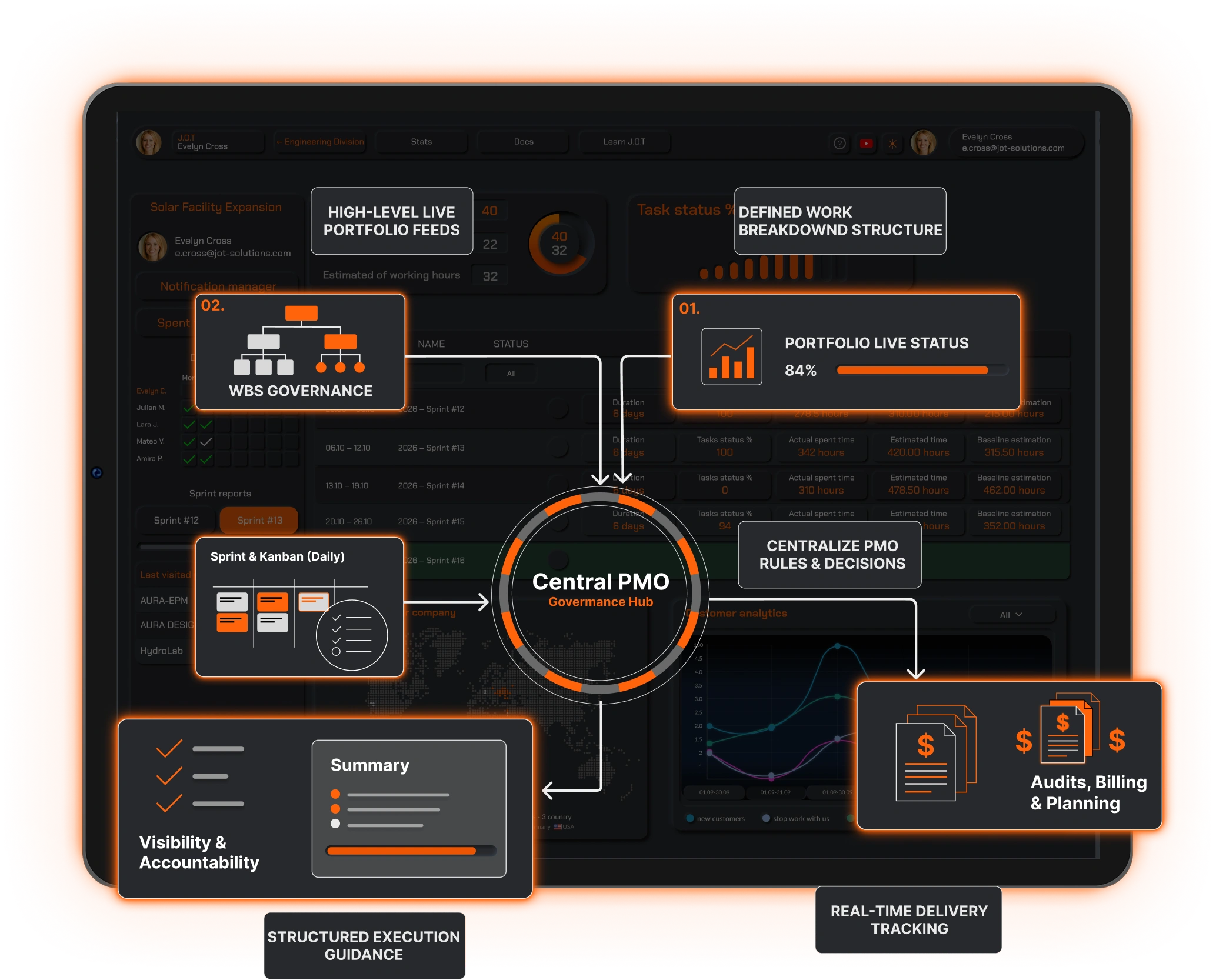
J.O.T APP is PMO software for project management offices that need visibility across teams and projects without creating a reporting burden on the people doing the work. Every sprint, every task, every timesheet, and every daily report feeds into a shared project record — so the PMO sees delivery status in real time, not at the end of the week when someone assembles it manually.
The PMO Challenge
PMOs lose visibility when execution
and reporting live in separate systems
Most PMOs face the same tension: the need for structure, standards, and visibility on one side — and delivery teams that need to move fast without being buried in process on the other. When reporting and execution are disconnected, both sides lose.
Visibility comes too late
Project status reaches the PMO through weekly reports, status meetings, and manual summaries. By the time the PMO sees a problem, it has already affected delivery. Real-time visibility requires real-time data — and most PMO software tools are not connected to where the work actually happens.
Standards without adoption
The PMO defines templates, processes, and reporting standards. Delivery teams use them inconsistently — because the tools they work in every day do not enforce the structure. Governance becomes a document that nobody reads and everybody ignores.
Portfolio view without project depth
Portfolio dashboards show RAG status and milestone dates. But when something turns red, the PMO cannot see why — because the dashboard is one level removed from the actual task, sprint, and team activity underneath it.
How J.O.T APP Works for PMOs
One PMO software system —
from project structure to portfolio visibility
J.O.T APP gives PMOs a single layer of structure that delivery teams actually work inside. The PMO defines the project framework — WBS categories, sprint cadence, task templates, status definitions. Teams execute inside that framework. Reporting flows upward from real work, not from manually assembled summaries. The PMO does not need to chase updates. The system shows them.
01
The PMO sets the structure
WBS categories, task templates, sprint schedules, and status definitions are defined once at the project level. Every team member works inside that structure — consistently, across every project.
02
Teams execute inside the framework
Delivery teams manage their work through tasks, sprints, and Kanban boards — the same tools they would use in any project management system. The difference is that their work is already tagged to the PMO's reporting structure from the moment it begins.
03
Daily reports give the PMO real-time signal
Team members create daily reports based on tasks completed. The PMO sees delivery activity as it happens — not summarized, not filtered, not delayed by a weekly reporting cycle.
04
Portfolio visibility without a separate reporting layer
Sprint reports, timesheet data, WBS progress, and daily logs feed into the project record continuously. The PMO has a live view of every project's execution status — filterable by team, by sprint, by WBS category, or by contractor.
What’s Inside
PMO software tools for structure,
visibility, and delivery discipline
J.O.T APP gives PMOs the governance layer they need and delivery teams the execution tools they actually use — in one connected system.
WBS-based project structure
Define work breakdown structures that organise every project into phases, disciplines, and deliverable categories. Every task belongs to a WBS node — making progress traceable at any level of the project hierarchy.
Task templates and standards
Create reusable task templates that enforce consistent structure across projects and teams. Standard deliverables, review processes, and approval workflows start from the same baseline every time.
Sprint management and Kanban visibility
Delivery teams work in sprints with full Kanban visibility. The PMO sees sprint progress, task status, and delivery pace across all active projects — without interrupting the teams doing the work.
Daily reports and sprint reporting
Team members create daily reports from completed tasks. Sprint reports aggregate delivery data across the full sprint period. The PMO accesses structured reporting that comes from real execution activity — not from manually compiled summaries.
Timesheets connected to project structure
Every logged hour connects to a WBS category, a sprint, and a project record. The PMO sees time allocation across projects, disciplines, and contractors — with the detail needed for billing, audits, and resource planning.
Multi-project portfolio view
Manage multiple active projects from one system. Filter by project, team, sprint, WBS category, or contractor. The PMO maintains portfolio visibility without switching between separate project tools or requesting manual status updates.
PMO Structure
What the best PMO software actually needs to do
The best PMO software is not the one with the most dashboards. It is the one where the data in those dashboards comes from the teams doing the work — not from a separate reporting exercise that someone has to complete on top of their actual job.
Most PMO software tools are built around the reporting layer: status fields, RAG indicators, milestone trackers. They give the PMO visibility — but that visibility depends on delivery teams remembering to update a separate system accurately and on time. When they do not, the dashboard lies.
J.O.T APP is built from the execution layer up. Tasks, sprints, timesheets, and daily reports are the tools delivery teams use every day. The PMO’s visibility comes from that activity directly — not from a summary that sits one step removed from reality.
For IT PMO software specifically, this means development tasks, implementation work, and support cycles are all visible in the same project structure as planning and governance activity. The IT PMO does not need a separate tool to see what the delivery team is doing. It is all in the same system.
Software PMO teams — those managing software product development, platform delivery, or IT portfolio work — get the same benefit: a single execution layer that serves both the delivery team and the governance function without requiring either to do extra work for the other.
Agile Execution + PMO Discipline
PMO governance and agile delivery —
in the same system
The tension between PMO governance and agile delivery teams is usually a systems problem, not a culture problem. When the tools are different, the priorities diverge. When the tools are the same, governance and execution reinforce each other.
Agile speed without losing PMO visibility
Delivery teams run weekly sprints, manage work on Kanban boards, and log progress daily. The PMO sees sprint velocity, task completion, and delivery pace in real time — without slowing teams down with additional reporting requirements.
PMO structure without bureaucratic overhead
WBS categories, task templates, and sprint cadence give the PMO the consistency it needs across projects. Delivery teams work within that structure naturally — because the structure is built into the tools they use every day, not imposed as a separate process on top of them.
PMO vs Project Manager
PMO software vs project management software —
and why the distinction matters
A project manager runs a project. A PMO runs the system that makes projects run consistently. The tools they need are related but not identical.
A project manager needs task detail, sprint visibility, team communication, and delivery tracking for one project at a time. A PMO needs all of that — plus consistency across projects, portfolio-level visibility, governance standards, and reporting that does not depend on individual project managers remembering to update a central dashboard.
Most project management software is optimized for the project manager. The PMO is an afterthought — a reporting module, an export function, a dashboard bolted on top. J.O.T APP is built so that both the project manager and the PMO work inside the same system. The project manager manages execution. The PMO sees it. Neither needs to do extra work for the other.
For organisations managing multiple projects across engineering disciplines, AEC workstreams, or technical portfolios, this shared layer is what makes PMO software useful in practice — not just in theory.
Why J.O.T APP
PMO software that works
because delivery teams actually use it
PMO software fails when delivery teams treat it as a reporting obligation rather than a working tool. The PMO gets the visibility it asked for — and the data is two weeks old, inconsistently filled in, and disconnected from what is actually happening on the project.
Visibility that comes from real work
In J.O.T APP, the PMO's visibility comes from the same activity that the delivery team records for their own work: task updates, time logs, daily reports, and sprint progress. There is no separate PMO reporting layer. The data is current because the team is using the system to do their work — not to report on it separately.
Structure that scales across projects
J.O.T APP gives PMOs a consistent project structure — WBS, sprints, task templates, status definitions — that applies across every project in the portfolio. New projects start from the same baseline. Reporting is comparable across projects. The PMO can see patterns, not just individual project status.
See How It Works
See how J.O.T APP works for your PMO
J.O.T APP connects project execution and PMO visibility in one system. Book a demo and we will show you how it works across your specific project portfolio and team structure.
Help Center
Frequently asked questions
Quick answers to questions you may have. Can't find what you're looking for? Check out our full documentation.
PMO software gives project management offices the tools to define project standards, monitor delivery across multiple projects, and maintain portfolio visibility. In J.O.T APP, PMO software works by connecting the execution layer — tasks, sprints, timesheets, and daily reports — directly to the governance and reporting layer, so the PMO sees real delivery status without a separate reporting process.
Project management software helps a project manager run one project — tasks, timelines, team communication, and delivery tracking. PMO software gives the project management office visibility and governance across multiple projects simultaneously. J.O.T APP serves both: project managers work inside tasks and sprints, while the PMO sees portfolio-level delivery status from the same system.
A PMIS — Project Management Information System — is a system that centralises project data: tasks, schedules, costs, resources, and reports. PMO software is typically built on top of a PMIS or functions as one. J.O.T APP serves as a practical PMIS for engineering, AEC, and technical teams: it centralises task execution, sprint data, timesheet records, and daily reporting in one connected system that both delivery teams and the PMO work inside.
Yes. J.O.T APP is built for PMOs that need governance consistency alongside agile delivery speed. Delivery teams run weekly sprints and manage work on Kanban boards. The PMO sees sprint progress, task status, and portfolio delivery in real time — without adding a separate reporting requirement on top of the team's existing workflow.
In J.O.T APP, every task, sprint, timesheet entry, and daily report is connected to the project structure the PMO defines. Portfolio visibility comes from filtering that live data by project, team, WBS category, sprint, or contractor — not from a separate dashboard that someone has to populate manually. The PMO sees delivery status as it happens, not after it has been summarised.
Yes. J.O.T APP works well for IT PMOs managing development delivery, platform projects, implementation work, and technical operations. Tasks, sprints, and reporting are structured the same way across IT and non-IT projects — so the PMO can maintain consistent governance and portfolio visibility regardless of the type of work being delivered.
Drop us a line.
We'll hear from you soon.
Need a quick question answered? Our support team is available to answer any queries seven days a week.
Contact information:
Email: appjot@jot-s.com